

Over the past year, Windsurf has stood out as one of the best AI IDEs devs can get their hands on. But in a surprising turn of events, the founders of the company, including CEO Varun Mohan, were acquired by Google DeepMind for $2.4 billion. Yes, OpenAI’s planned $3 billion purchase failed. Mohan, Chen, and key Windsurf R&D engineers are now working on Google’s Gemini, while the Windsurf IDE continues under interim CEO Jeff Wang. This change highlights the evolving nature of Windsurf’s ‘backend.’ However, it raises a question: will Windsurf continue to thrive, or will it lose its special substance under the new leadership? And if the latter holds, are there any good alternatives that you, the developer, should consider? The answer is yes.
Bind AI has quietly matured into a polished alternative: a multi‑model, cloud‑native IDE that lets solo developers, founders, and teams write, run, debug, document, and deploy without switching tools. Let’s compare the two from the ground up.
At A Glance: Windsurf vs Bind AI
Windsurf

- Marketed as the first “agentic IDE”, combining Copilot‑style assistance with autonomous agents (“Cascade”) that think ahead.
- Designed for in‑flow, multi‑file editing and complex automation like building entire features or fix‑and‑run loops.
- Borrowing the famous “cannibalize your own product every 6–12 months” startup culture, it prioritizes disruptive shifts over incremental improvement.
Bind AI
- Positioned as an all‑in‑one web IDE: code editor, debugger, preview, GitHub sync, docs, and AI‑powered Assistant all blended into one workspace.
- Built around a flexible multi‑model architecture, including Claude 4, GPT-4.1, Gemini 2.5 Pro, plus some open‑source variants—no vendor tie‑in.
- Offers BYOK (Bring‑Your‑Own‑Key), so you aren’t rate‑limited by API quotas.
- Focused on pragmatic, solo‑dev use cases: side‑projects, landing pages, backend scripts, complete clones—even HTML email campaigns.
What is Bind AI?
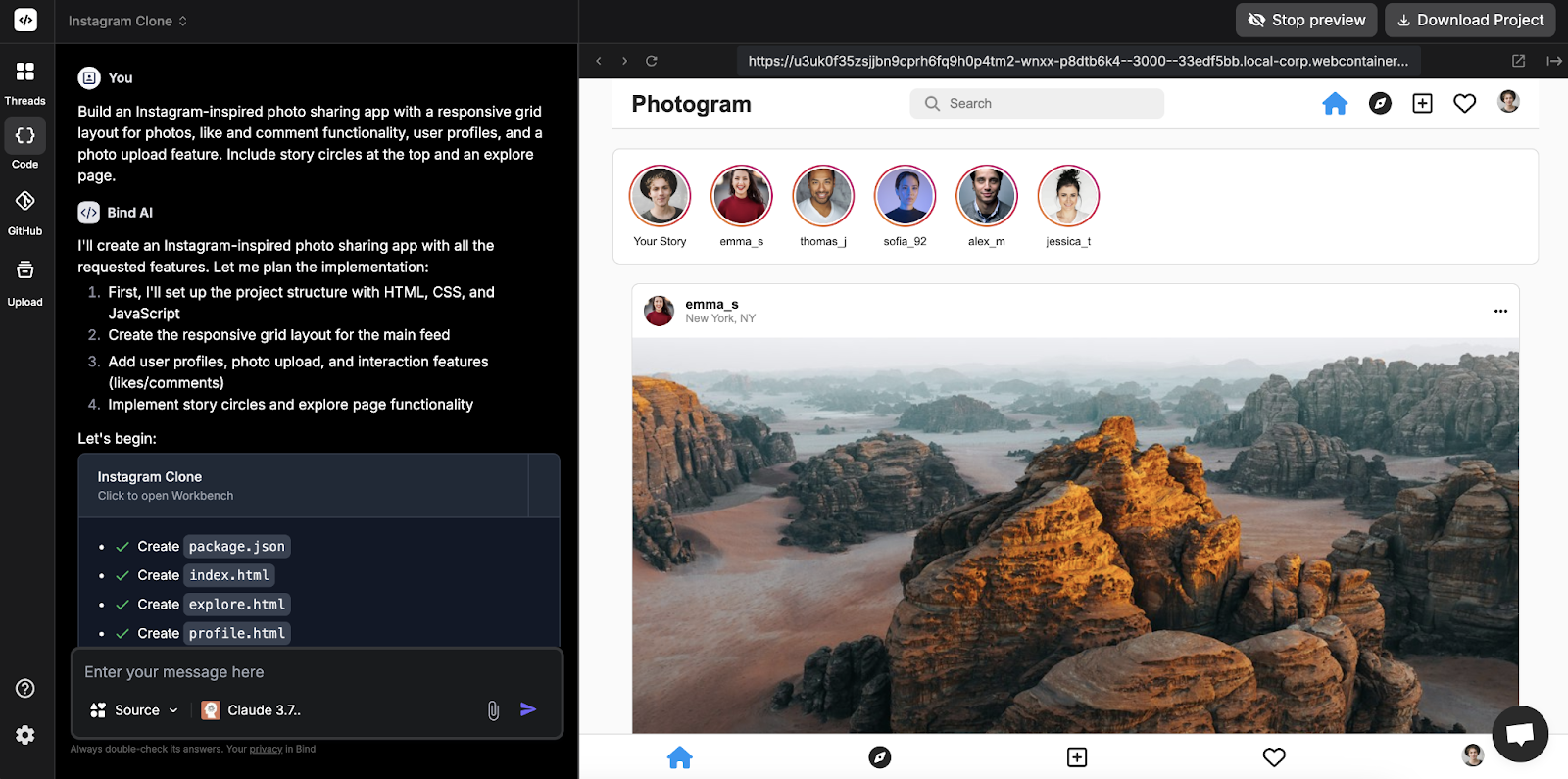
Bind AI is a web-based, AI-powered code assistant and IDE designed to streamline the development process. Already used by 13,000+ developers and builders, it combines advanced AI models—including Claude 4 (with paid plans), GPT-4.1, O3, and Gemini 2.5 Pro—with a robust online editor. While not yet at full feature parity with Windsurf, Bind AI is purpose-built for solo developers, small teams, agencies, and low-tech users.
You can create software projects in any language, use a web-based terminal and preview for JavaScript and limited Python projects, and download the rest. GitHub integration and Agent Mode 1.0 allow for automated project creation and execution.
What makes Bind AI stand out?
- Advanced AI Models: Bind AI provides access to over 15 AI models, including Claude 4 Sonnet, GPT-4.1, and Gemini 2.5 Pro, allowing developers to choose the best model for their task.
- Integrated Online IDE: The built-in code editor supports real-time code execution, debugging, and HTML web page previews, eliminating the need for external tools.
- Support for 72+ Programming Languages: From mainstream languages like Python, Java, and JavaScript to specialized ones like Swift and Fortran, Bind AI caters to diverse project needs.
- GitHub Integration: Developers can sync their repositories and files, facilitating seamless project management and collaboration.
- File Uploads and Automation: Supports file uploads up to 2MB and connects to various data sources for task automation.
- Pricing: Starts at $18/month for the Pro plan, with a 7-day free trial, making it accessible for solo developers.
- User-Friendly Interface: The web-based platform is intuitive, with a split-screen interface for real-time code generation and editing.
Bind AI’s web-based nature eliminates the need for local installation, making it ideal for developers who prioritize convenience and accessibility.
What’s next for Bind AI:
- Agent mode 2.0 for a truly agentic coding flow.
- Revision history and dependency graph for complex code revisions.
- Push/Pull to GitHub via MCP Server.
- Team collaboration on projects and repositories.
What is Windsurf?

Windsurf, formerly known as Codeium, is an AI-native IDE that emphasizes deep integration with AI to enhance coding efficiency. Its flagship feature, the Cascade AI agent, provides advanced contextual awareness, making it a powerful tool for complex projects. However, the recent departure of its leadership to Google has introduced uncertainty about its future.
What made Windsurf stand out?
- Cascade AI Agent: Offers deep codebase understanding, enabling autonomous tasks like multi-file code generation, terminal command execution, and error correction.
- Supercomplete and Memories: Provides advanced autocomplete (Supercomplete) and a Memories feature for storing and reusing code snippets.
- Indexing Engine: Enhances suggestion accuracy by analyzing the entire codebase, ideal for large projects.
- Multi-Platform Support: Available on Mac, Windows, and Linux, offering a native coding experience.
- Privacy and Security: Features clear opt-out telemetry and robust privacy measures.
- Pricing: Offers a free tier with limitations and paid plans starting at $15/month for the Pro plan.
The departure of Windsurf’s founders to Google DeepMind, along with several R&D team members, as part of a $2.4 billion nonexclusive licensing deal, has raised concerns about the tool’s future development and support. While Windsurf remains operational, solo developers may worry about its long-term reliability.
Bind AI vs Windsurf: Comparison of Features
To determine which IDE is better suited for solo developers, we compare Bind AI and Windsurf across several critical dimensions:
AI Integration
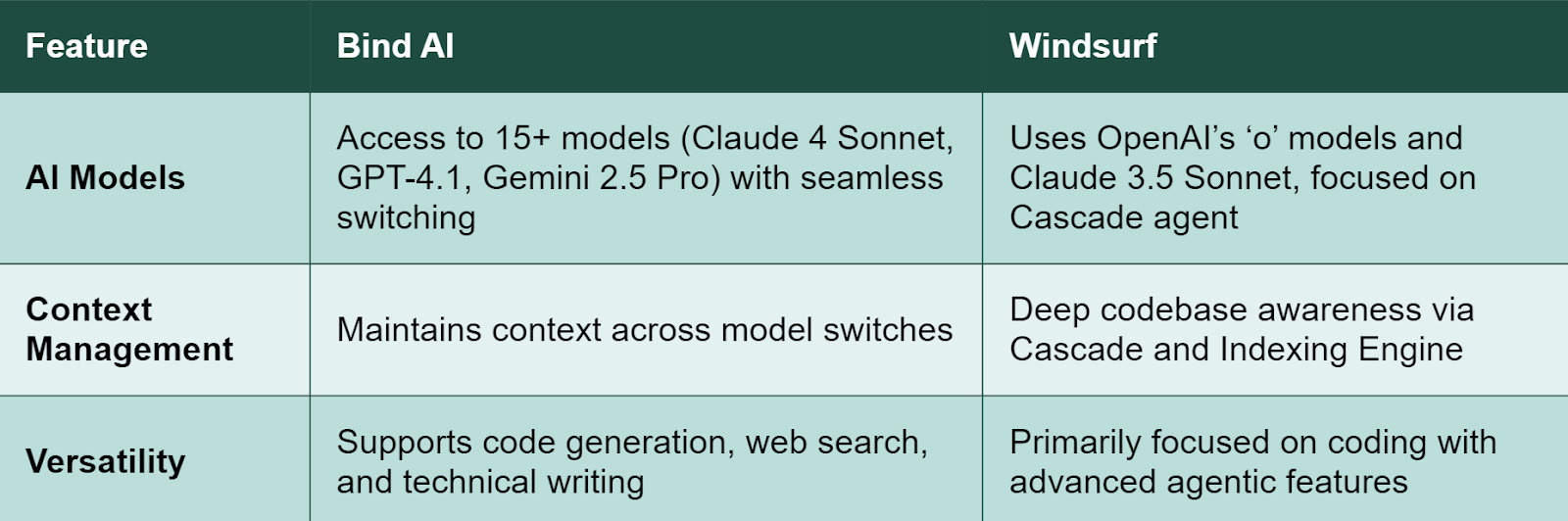
Analysis: Bind AI’s broader range of AI models and flexibility make it more versatile for solo developers working on diverse tasks. Windsurf’s Cascade is powerful for coding-specific tasks but lacks the same breadth of model options.
IDE Functionality
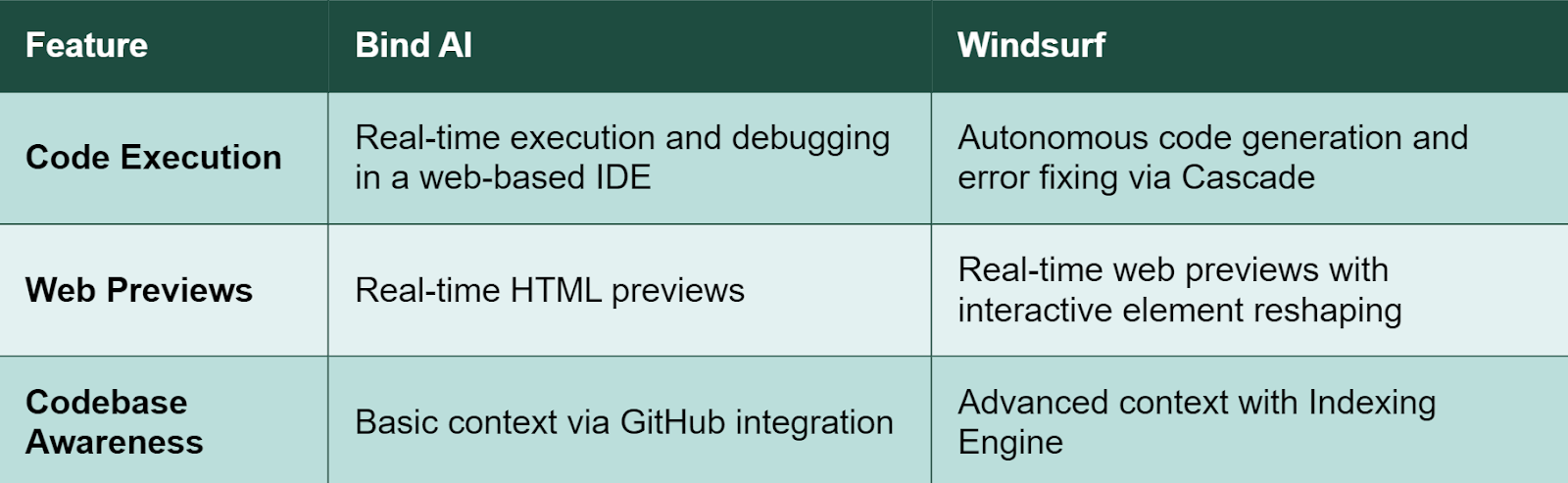
Analysis: Windsurf’s Cascade offers more advanced, autonomous functionality, but Bind AI’s straightforward IDE is easier to use for solo developers who don’t need complex agentic features.
Usability
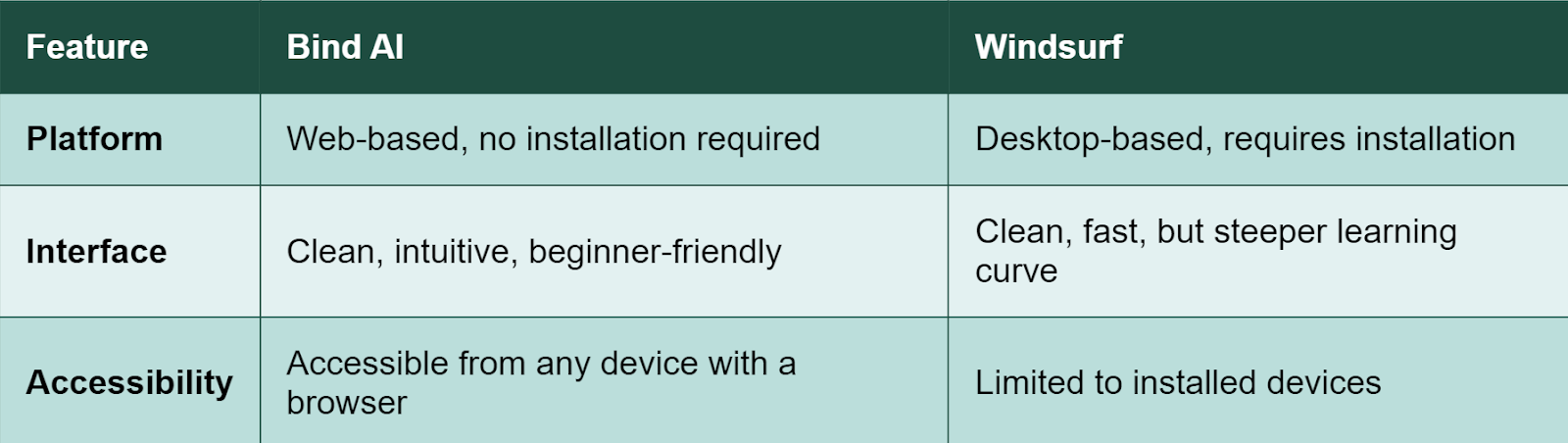
Analysis: Bind AI’s web-based platform is a significant advantage for solo developers who value accessibility and ease of use. Windsurf’s desktop application offers a native experience but may be less convenient.
Pricing
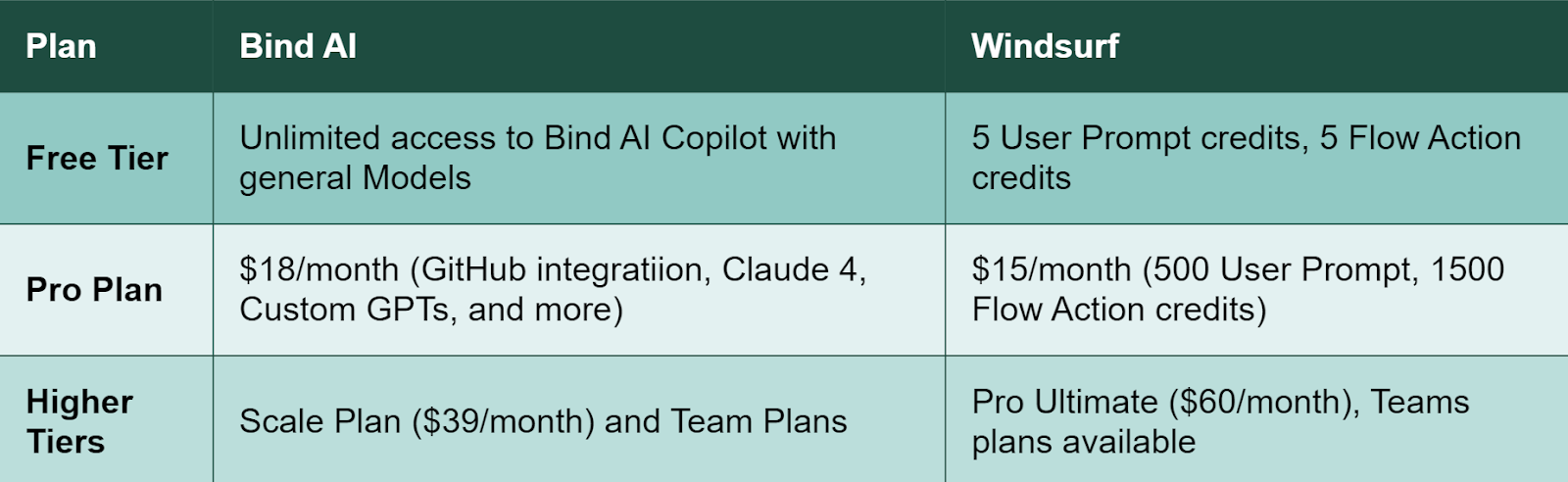
Analysis: Windsurf’s lower entry price is attractive, but its free tier is more restrictive. Bind AI’s free plan and transparent pricing make it a viable option for solo developers.
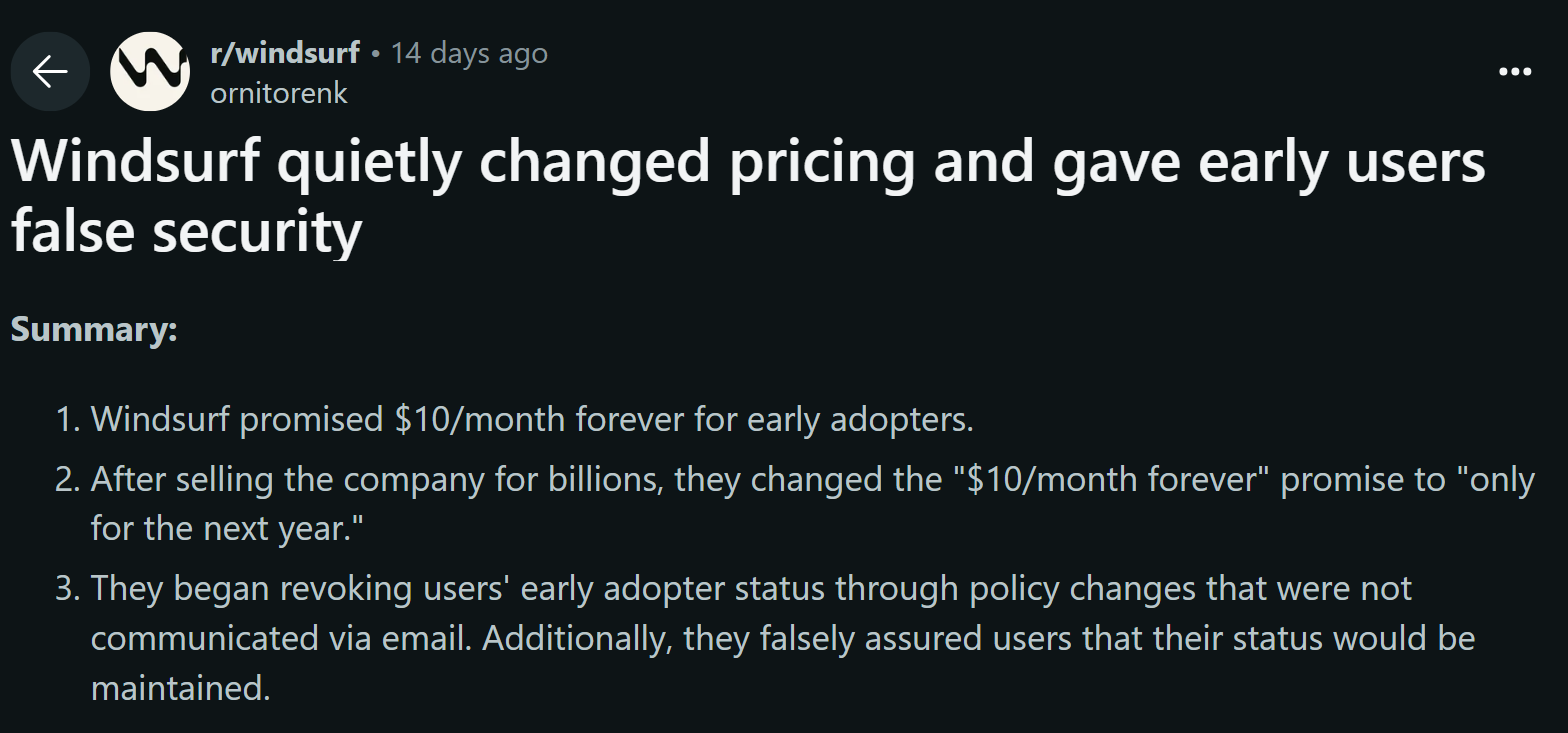
Windsurf’s pricing has become exorbitant—Pro jumped from $10 to $15/month, credits deplete fast, and early adopters weren’t honored properly. Complaints flooded in about confusing credit tiers and unexpected overcharges. Bind AI fixes this by offering transparent, reliable pricing—no hidden credits or surprise fees—and ensures long-term users get fair value from day one.
Community and Support

Analysis: Bind AI’s active development and growing community provide reassurance for solo developers. Windsurf’s leadership changes introduce risks that may concern those relying on long-term support.
Suitability for Solo Developers
Solo developers prioritize tools that are easy to use, cost-effective, and reliable. Here’s how Bind AI and Windsurf compare:
- Ease of Use: Bind AI’s web-based interface requires no setup, making it ideal for developers who want to start coding immediately. Its intuitive design is accessible to beginners and experienced developers alike. Windsurf, while powerful, has a steeper learning curve due to its advanced features and desktop-based setup.
- Cost-Effectiveness: Both tools offer free tiers. Windsurf’s free tier is limited, and its paid plans, while cheaper, may not provide the same level of versatility. Bind AI’s paid tiers may offer greater flexibility despite being a tad expensive.
- Future-Proofing: The departure of Windsurf’s founders to Google raises concerns about its future development, which is a critical consideration for solo developers who need reliable tools. Bind AI, with its active maintenance and growing ecosystem, offers greater stability.
Try These Samples
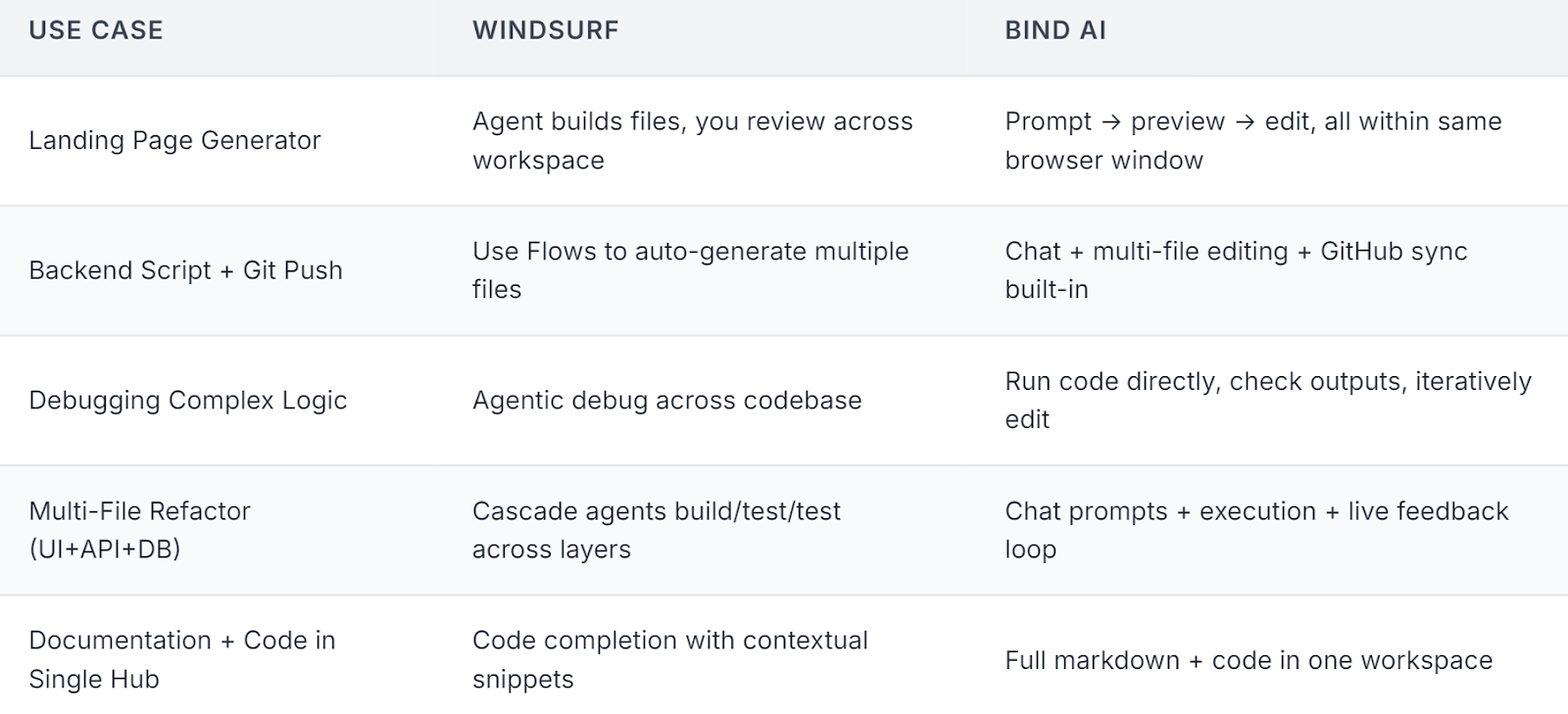
Try some samples to test both Bind AI and Windsurf and see which one produces better results:
The Bottom Line
For solo developers, Bind AI is a reliable choice in uncertain times. Its browser-based platform eliminates installation hassles and supports over 70 programming languages, making it a versatile toolbox. Seamless integrations with GitHub and Google Drive allow for efficient management of code and documentation. With an affordable price, a solid free trial, and BYOK options, it offers great value.
While Windsurf has impressive features like the Cascade AI agent, its future seems uncertain after the departure of key leaders to DeepMind and the failed OpenAI acquisition. With a diminished team, solo developers may question whether they can navigate the storm ahead.
Looking to 2025, Bind AI stands strong as a dependable IDE for solo developers, cost-efficient and evolving. It’s not just a tool but a trusted partner, while Windsurf remains a mix of potential and risk. Try Bind AI now!

